
Prof. Fung KWAN
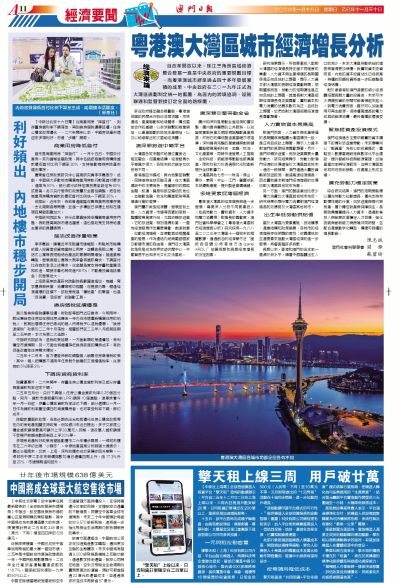
Analysis of urban economic growth in the Guangdong-Hong Kong-Macao Greater Bay Area
On January 18, 2026, Prof. Fung KWAN, Assistant Professor of Economics in the Faculty of Social Sciences at the University of Macau and a member of the Macao Economy team of the Asia-Pacific Academy of Economics and Management, together with research team members Dr. Chi Shing CHAN and Dr. Pek U SOU, published an analysis in Macao Daily News examining urban economic growth within the Guangdong-Hong Kong-Macao Greater Bay Area (GBA).
Drawing on data from the 11 GBA cities between 1988 and 2023, the study applied a panel autoregressive distributed lag model for empirical analysis. Findings indicate that all examined factors (including labor, physical capital, human capital, and electricity consumption) positively contribute to economic growth across the GBA. Human capital emerges as particularly vital for long-term growth, while labor growth, physical capital investment, and electricity consumption serve as primary short-term drivers.
The research also underscores the distinct functional roles and growth trajectories of different cities. Hong Kong specializes in high-value-added services, functioning as an international financial, shipping, and trade hub. Guangzhou and Shenzhen act as “twin engines,” spearheading development in knowledge services and technological innovation. The remaining cities focus on elevating manufacturing value chains.
For Macao, the study highlights the unique nature of its economic structure. The region’s dependence on labor—especially within the tourism sector—and physical capital, such as investments in tourism infrastructure, is markedly higher than in other GBA cities, consistent with its role as a world tourism and leisure center. However, the economic influence of electricity consumption remains relatively limited, reflecting Macao’s small-scale manufacturing sector.
Additionally, the analysis warns of potential challenges if the GBA continues to depend predominantly on traditional growth factors, including slowing labor supply growth, spatial limitations on physical capital investment, and structural economic risks.
Regarding Macao’s development, the report offers strategic recommendations. In the short term, Macao should expand its labor force, prioritizing support for tourism and modern services to stabilize employment and livelihoods. Long-term strategies should emphasize economic diversification, shifting from heavy reliance on gaming and tourism toward an “asset-light” development model. This includes investing in data infrastructure, digital platforms, smart technologies, and energy management systems, alongside enhancing human capital and strengthening technical collaboration with other GBA cities.
This study provides valuable empirical insights into the economic dynamics of the Guangdong-Hong Kong-Macao Greater Bay Area and the coordinated development pathways of its cities.
For further details, please read the original news via this link.