
Prof. Rob Law
UM APAEM offers valuable insights for the Macao government and the tourism industry through organising international symposiums
In today’s challenging economic climate, innovation and technological advancement have become essential for driving new quality productive forces. The University of Macau (UM) is at the forefront of this effort, leveraging its role as a think tank to make meaningful contributions. Through its Centre for the Guangdong-Hong Kong-Macao Greater Bay Area Studies, UM conducts empirical research on Macao and regional development. It also supports Macao’s economic restructuring and policy-making efforts through the Asia-Pacific Academy of Economics and Management (APAEM) and the Centre for Macau Studies.
Driving Industry Transformation Through Smart Tourism Research
As a world centre for tourism and leisure, Macao’s ability to transform and upgrade its tourism industry is crucial to maintaining its competitiveness, driving economic growth, and creating high-quality employment opportunities. These efforts align directly with SDG8 (Decent Work and Economic Growth). From 2020 to 2024, UM’s research publications on this goal focused on the sustainable development of the tourism industry. By integrating economic growth theories, income distribution frameworks, and endogenous growth models, these studies provided valuable theoretical insights to support Macao’s economic diversification.
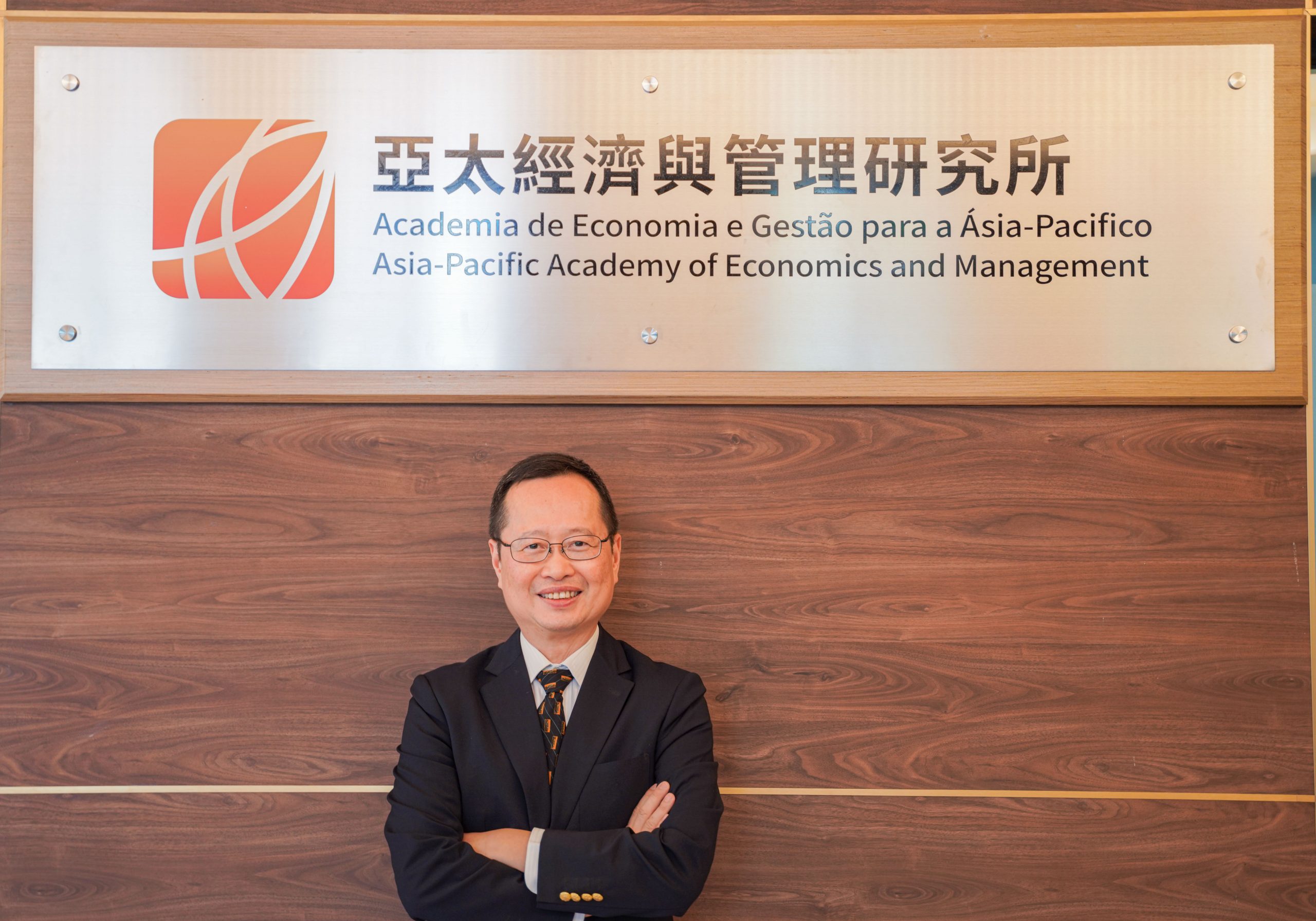
At the forefront of this initiative is Rob Law, UM Development Foundation Chair Professor of Smart Tourism, deputy director of APAEM, and chair professor in the Faculty of Business Administration. Under Prof Law’s leadership, UM’s smart tourism research team draws on perspectives from a wide range of disciplines, including information technology, management, social sciences, humanities and history, to conduct cross-disciplinary research that supports Macao’s ‘tourism+’ strategy.
According to a study published in Tourism Tribune that evaluated the influence of Chinese institutions in tourism studies based on SSCI-indexed tourism papers published from 2001 to 2023, UM ranked third in China with a score of 148.72. In a separate ranking from the same study that assessed research quality and cumulative research contribution, UM ranked fourth nationwide, achieving an h-index (research quality) of 34 and a g-index (cumulative research contribution) of 53, highlighting the university’s strong academic influence. Prof Law, who ranked first nationwide among individual researchers in both the h-index and g-index, emphasises that interdisciplinary collaboration is key to advancing smart tourism. His research has significant practical implications for tourism development, safeguarding tourists’ rights, and addressing the needs of specific customer groups.
One notable example of Prof Law’s work is the article Impacts of Mobile Payment-Related Attributes on Consumers’ Repurchase Intention. Based on the website evaluation conceptual model and the theory of planned behaviour, the study introduces a new framework for analysing factors that influence consumer satisfaction. Published in International Journal of Tourism Research, the paper was selected by leading international publisher Wiley as a ‘Top Cited Article 2022-2023’. The paper’s findings offer actionable insights for tourism operators seeking to optimise hotel booking processes. Prof Law notes, ‘We are also conducting research on topics such as smart medical tourism, guided tours of historical buildings using smart technology, personalised travel planning robots, and social media-based destination prediction. Through interdisciplinary efforts, we hope to provide fresh perspectives for diversifying the tourism industry.’
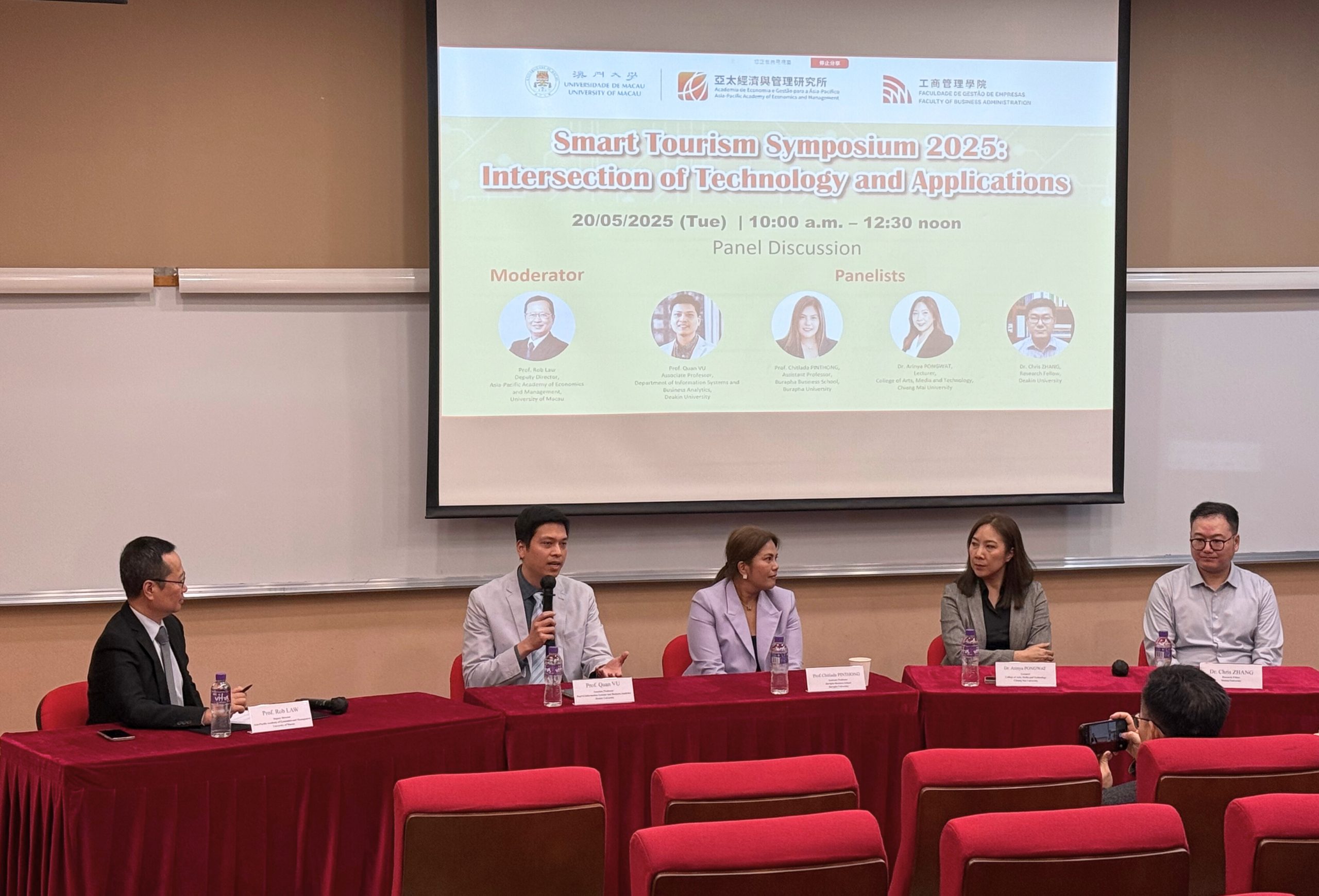
In addition to initiating visionary and practical academic research, APAEM serves as a platform for fostering collaboration between academia and industry. For example, the ‘Smart Tourism Symposium 2025: Intersection of Technology and Applications’ brought together international and local experts to explore cutting-edge smart tourism technologies and emerging trends. Topics included artificial intelligence (AI), big data analytics, augmented reality, virtual reality (VR), sentiment analysis, and facial recognition payment systems. The symposium not only showcased the latest advancements in intelligent and personalised tourism services but also bridged Macao’s academic research with global industry practices, offering valuable insights for the Macao government and the tourism industry to support industry transformation.
These initiatives also play an important role in expanding students’ perspectives. UM curriculum integrates research findings on smart tourism technologies, such as AI-based planning tools and VR tour guides, as well as sustainable tourism and cross-cultural communication. This equips students with a diverse skill set, including proficiency in digital tools and modern service concepts. In doing so, UM nurtures interdisciplinary talent with both technical expertise and humanistic qualities, preparing graduates for high-quality employment opportunities.
The research team also focuses on improving tourism demand forecasting and resolving data mismatches in the process. By refining forecasting methods and integrating diverse data sources, their work provides tourism practitioners and policymakers with reliable, evidence-based insights. This supports sustainable business decisions, destination planning, and the development of green supply chains, and also contributes to SDG12 (Responsible Consumption and Production).
Article excerpted from: 2025 UMagazine 32 — “Fostering Innovation to Drive Economic Diversification and Industry Transformation”